Please fill out the form below, and we will get back to you as soon as possible.
27
May
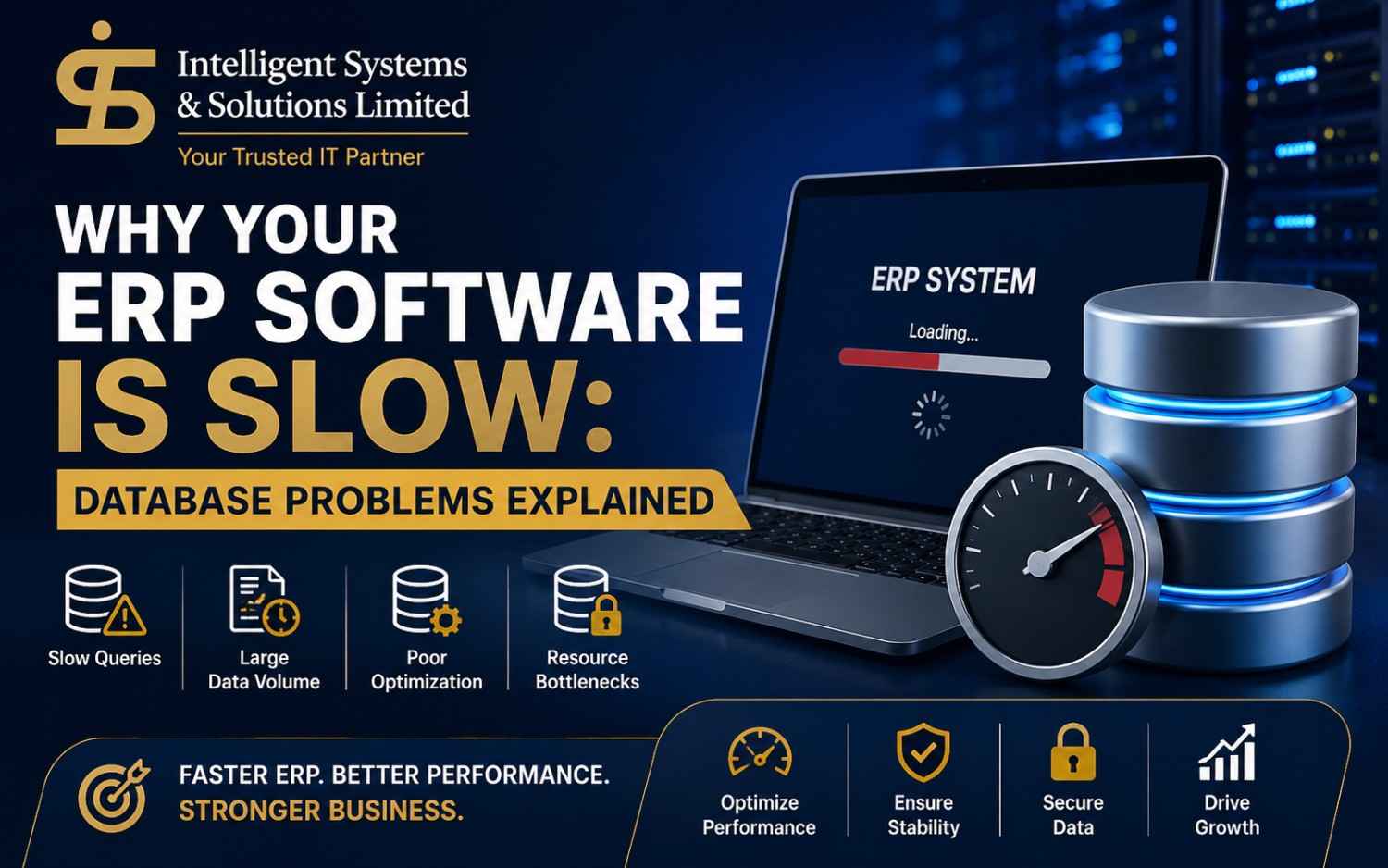
ERP software is the operational backbone of modern businesses. From inventory management and HRM to accounting, CRM, and production management — businesses rely on ERP systems daily.
However, many companies experience a common and frustrating problem:
Most businesses blame the software itself. But in reality, the biggest reason behind slow ERP systems is poor database management.
In this guide, we will explain:
ERP software depends heavily on databases.
Every action inside an ERP system interacts with the database:
As businesses grow, the database grows rapidly.
Without proper database systems management and support, ERP performance gradually declines.
One of the most common causes of slow ERP performance is unoptimized databases.
Over time:
This causes ERP software to:
Database optimization improves response speed and overall ERP performance.
ERP systems rely heavily on SQL queries.
Poorly written or unoptimized queries can overload the database server.
Common SQL performance problems include:
Slow SQL queries directly affect:
Professional SQL performance tuning helps improve execution speed significantly.
Indexes help databases retrieve data quickly.
Without proper indexing:
Incorrect or missing indexes force databases to scan entire tables repeatedly.
This increases:
Regular index optimization is critical for ERP database performance.
As companies continue operating, ERP databases grow rapidly.
Large databases without maintenance create:
Businesses often store:
Without database cleanup and archiving strategies, ERP performance decreases over time.
ERP systems require sufficient:
Even a properly optimized ERP database may perform poorly if the server infrastructure is weak.
Common infrastructure problems include:
Enterprise ERP systems require scalable database infrastructure.
Frequent updates, inserts, and deletions fragment database storage structures.
Fragmented databases:
Database fragmentation becomes severe in:
Regular database maintenance helps prevent fragmentation issues.
As businesses grow, more employees access ERP systems simultaneously.
This increases:
Without proper optimization:
High-concurrency environments require advanced database tuning and load management.
Complex reports consume significant database resources.
Common reporting problems include:
Poorly optimized reports can slow down the entire ERP system.
Database experts optimize reporting queries to improve performance.
Many companies schedule backups during working hours.
This creates:
Professional database backup strategies minimize operational impact while ensuring data protection.
Most businesses only react when ERP systems become extremely slow.
Without continuous database monitoring:
Database monitoring helps identify:
Preventive monitoring improves ERP stability significantly.
ERP performance issues affect the entire organization.
Employees waste time waiting for:
This reduces operational efficiency.
Slow ERP reports delay business decisions.
Management requires fast access to:
Database performance directly impacts decision-making speed.
Slow ERP systems affect customer experience.
Examples:
This damages customer trust and business reputation.
Poor ERP performance increases:
Businesses often spend more fixing problems later instead of optimizing proactively.
Database tuning improves:
Key optimization techniques include:
SQL optimization reduces:
This improves overall ERP responsiveness.
Removing unnecessary data improves performance.
Optimization activities include:
Professional database administrators regularly:
This improves ERP data retrieval speed.
ERP performance also depends on infrastructure quality.
Businesses should consider:
Performance is important, but security is equally critical.
ERP databases contain:
Professional database systems management includes:
Optimized databases improve software responsiveness significantly.
Preventive maintenance reduces unexpected failures.
Optimized SQL queries generate reports faster.
Employees work more efficiently with fast ERP systems.
Professional management protects business-critical information.
Optimized infrastructure supports growing operational demands.
Businesses should seek professional support if they notice:
These are strong indicators of database performance issues.
ERP database optimization requires specialized expertise.
Professional database experts understand:
Experienced database administrators can identify performance bottlenecks quickly and improve ERP speed dramatically.
ISSL database experts have experience working with both local and international businesses, delivering enterprise-grade database systems management and support solutions.
Production systems require fast real-time data processing.
Inventory and production tracking databases require continuous optimization.
POS and inventory systems depend heavily on database speed.
Hospital ERP systems require secure and stable database environments.
Accounting and financial software require high-performance databases.
Modern ERP systems continue evolving with:
As data volumes increase, professional database management becomes even more important.
Businesses investing in ERP database optimization gain:
Slow ERP software is often caused by underlying database problems rather than the ERP application itself.
Poor database management leads to:
Professional ERP database optimization improves:
Organizations should proactively invest in database systems management and support to maintain efficient ERP operations and business continuity.
ISSL provides professional ERP database optimization, SQL performance tuning, Oracle database support, SQL Server management, backup solutions, and enterprise database services for businesses of all sizes.
With experience in both local and international markets, ISSL delivers reliable and high-performance database management solutions.
Intelligent Systems and Solutions Limited (ISSL) is a technology-driven software and IT solutions company specializing in enterprise database systems management, ERP solutions, software development, infrastructure support, and digital transformation services.
With experience in both local and international markets, ISSL provides professional database management and support services for businesses that depend on high-performance, secure, and reliable database environments.
Our team of database experts works with enterprise technologies including:
ISSL helps organizations optimize database performance, improve ERP system speed, strengthen database security, implement backup and disaster recovery solutions, and maintain business continuity through enterprise-grade database administration services.
We support businesses across multiple industries including:
Our database systems management and support services include:
At ISSL, we believe that reliable databases create stronger businesses. Our goal is to help organizations maintain secure, scalable, and high-performing systems that support operational growth and long-term success.
As a trusted IT partner, Intelligent Systems and Solutions Limited continues to deliver enterprise-grade technology solutions designed to improve efficiency, reliability, and digital transformation for modern businesses.
📞 Phone: 01911520552
📩 Email: info.isslbd@gmail.com
🌐 Website: intelligentsystemsltd.com
Professional ERP Database Optimization, SQL Server Support, Oracle Database Management, Backup & Recovery, and Enterprise Database Systems Management Services.