Please fill out the form below, and we will get back to you as soon as possible.
29
May
In today's competitive business environment, speed matters.
Employees expect ERP systems to load instantly. Managers need reports generated within seconds. Customers demand seamless digital experiences. Yet many organizations struggle with slow applications, delayed reporting, and poor software performance.
The surprising reality is that the software itself is often not the problem.
In many cases, the underlying Microsoft SQL Server database is the real bottleneck.
Whether your organization uses ERP software, accounting systems, CRM platforms, HRM applications, inventory management solutions, or custom business applications, database performance directly impacts productivity, customer satisfaction, and business growth.
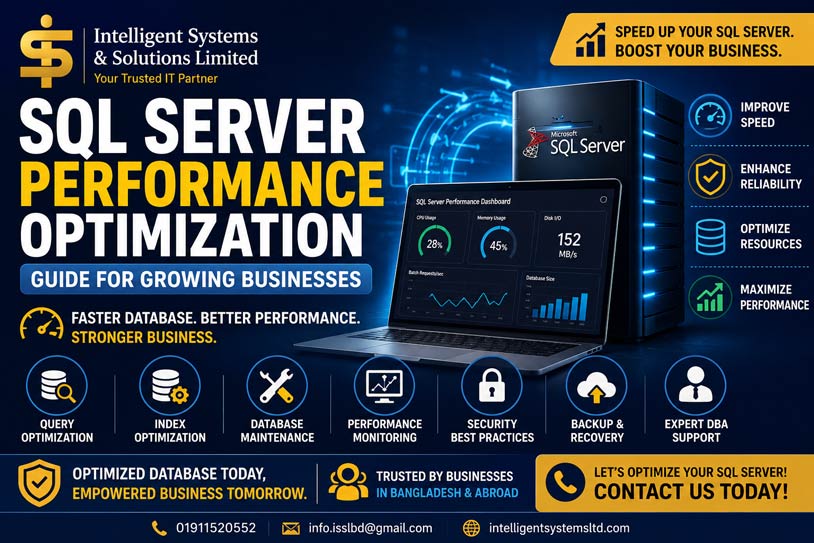
This guide explores SQL Server performance optimization strategies that help organizations improve database speed, reliability, security, and scalability.
Microsoft SQL Server is one of the world's most widely used relational database management systems (RDBMS).
Organizations across industries rely on SQL Server to power:
ERP Systems
Accounting Software
Inventory Management Systems
CRM Applications
Human Resource Management Systems
Healthcare Solutions
Educational Platforms
Enterprise Applications
SQL Server is trusted because it provides:
Reliability
Security
Scalability
Reporting capabilities
Business intelligence integration
Enterprise-level performance
However, without proper database administration and optimization, SQL Server environments can gradually become slower and less efficient.
Many business leaders underestimate the impact of database performance on overall operations.
A slow database affects every department.
Delayed financial reports slow decision-making.
CRM systems become sluggish.
Attendance and payroll processing take longer.
Inventory and production tracking become inefficient.
Critical business insights are delayed.
Poor database performance creates a ripple effect throughout the organization.
Many businesses continue operating with inefficient databases without realizing the long-term impact.
Common warning signs include:
Slow ERP performance
Delayed report generation
High CPU utilization
Long application response times
Frequent timeout errors
Database locking issues
Excessive memory usage
Slow backup operations
Increased downtime
These symptoms often indicate deeper SQL Server performance issues.
Understanding the root causes helps organizations implement effective solutions.
One of the most common performance issues involves inefficient SQL queries.
Poorly written queries:
Consume excessive resources
Increase execution times
Slow down applications
Indexes help SQL Server locate data quickly.
Without proper indexing:
Reports become slow
Searches take longer
Resource consumption increases
As businesses grow, databases expand significantly.
Large databases require:
Proper maintenance
Capacity planning
Performance monitoring
Without optimization, database growth can severely affect performance.
Even well-optimized databases require sufficient infrastructure.
Common issues include:
Insufficient RAM
Slow storage systems
CPU bottlenecks
Network latency
Many organizations implement SQL Server but fail to perform ongoing maintenance.
Over time:
Index fragmentation increases
Statistics become outdated
Query performance degrades
Regular maintenance is essential for long-term performance.
Query optimization is often the fastest way to improve SQL Server performance.
Execution plans reveal how SQL Server processes queries.
Database administrators can identify:
Table scans
Expensive operations
Missing indexes
Retrieve only necessary data.
Avoid:
SELECT *
Instead, request specific columns.
Efficient WHERE clauses improve query performance significantly.
Complex joins often cause performance bottlenecks.
Review and optimize relationships between tables regularly.
Indexes are among the most powerful performance tools available.
Faster searches
Improved reporting
Reduced resource consumption
Better application responsiveness
| Maintenance Activity | Benefit |
|---|---|
| Rebuild Indexes | Improved performance |
| Reorganize Indexes | Reduced fragmentation |
| Remove Unused Indexes | Better resource efficiency |
| Create Missing Indexes | Faster data retrieval |
Regular index maintenance is essential for enterprise environments.
Optimization should be continuous rather than reactive.
Organizations should monitor:
High CPU usage often indicates inefficient queries.
Insufficient memory can slow database operations.
Storage bottlenecks affect transaction speed.
Identify slow-running queries before they impact users.
Forecast future resource requirements.
Continuous monitoring helps prevent major performance issues.
Performance is important, but security is equally critical.
Business databases often contain:
Financial information
Employee records
Customer data
Operational information
Best practices include:
Role-based access control
Multi-factor authentication
Encryption
Security auditing
Patch management
A secure database environment protects business continuity and reputation.
Many ERP systems rely heavily on SQL Server.
Examples include:
Manufacturing ERP
Inventory Management Systems
Accounting Platforms
Human Resource Systems
ERP database optimization improves:
Transaction speed
Reporting performance
User experience
Operational efficiency
Businesses often experience dramatic performance improvements after proper database tuning.
Managing enterprise SQL Server environments requires specialized expertise.
Professional DBA services help businesses:
Improve database performance
Reduce downtime
Enhance security
Optimize infrastructure
Implement disaster recovery plans
Support business growth
Experienced database administrators proactively identify and resolve issues before they affect operations.
Intelligent Systems and Solutions Limited (ISSL) provides professional SQL Server database management and support services for organizations seeking reliable, secure, and high-performing database environments.
Our services include:
Comprehensive database management.
Advanced optimization strategies.
Proactive issue detection.
Business continuity protection.
Enterprise-level database security.
Improved software performance and scalability.
Our database experts have experience supporting both local and international businesses with enterprise-grade database solutions.
SQL Server performance directly impacts business productivity, operational efficiency, and customer satisfaction.
Organizations that proactively optimize their SQL Server environments benefit from:
Faster software performance
Better reporting
Reduced downtime
Improved security
Greater scalability
As businesses continue to rely on data-driven operations, SQL Server optimization becomes a strategic investment rather than a technical task.
Companies that prioritize database performance gain a competitive advantage through faster systems, improved decision-making, and more efficient operations.
Professional SQL Server Administration, Database Optimization, ERP Database Support, Performance Tuning, Security Management, Backup & Recovery, and Enterprise DBA Services.
📞 01911520552
🌐 intelligentsystemsltd.com
Local Expertise. International Experience. Enterprise Database Excellence.