Please fill out the form below, and we will get back to you as soon as possible.
27
May
Modern businesses run on data. Whether it is ERP software, accounting systems, CRM platforms, HRM systems, eCommerce platforms, or enterprise applications — databases are the backbone of every digital operation.
When databases become slow, unstable, unsecured, or poorly maintained, businesses suffer from:
This is why professional database systems management and support has become essential for modern organizations.
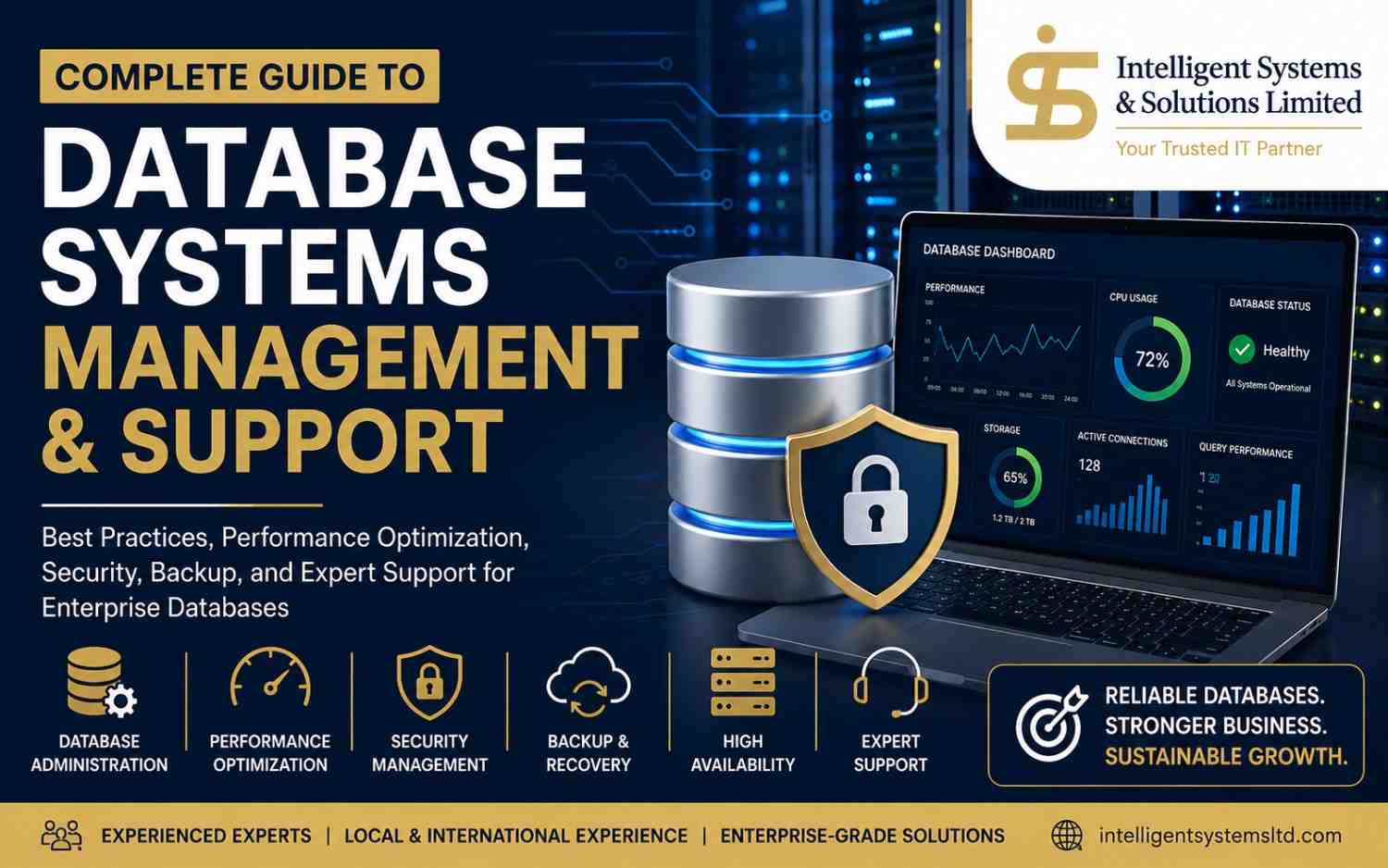
In this guide, we will explain everything businesses need to know about database management, database administration, performance optimization, database security, backup solutions, and enterprise database support.
Database systems management and support refers to the process of monitoring, maintaining, optimizing, securing, and supporting databases that power business applications and enterprise systems.
It includes:
The goal is to ensure that databases remain:
Professional database management helps businesses avoid downtime, data corruption, and performance issues.
Many companies invest heavily in ERP software, websites, or business applications but ignore the database infrastructure behind them.
Without proper database management:
A properly managed database system improves:
Enterprise businesses especially require high-performance database systems to manage large volumes of operational data efficiently.
Different businesses use different types of database systems depending on their requirements.
Oracle Database is one of the most powerful enterprise database management systems used globally.
It is widely used in:
Benefits of Oracle Database:
Oracle database management requires experienced DBA professionals to maintain performance and reliability.
Microsoft SQL Server is widely used by businesses for ERP systems, accounting software, and enterprise applications.
Advantages include:
SQL Server optimization is essential for maintaining software speed and application performance.
MySQL is a popular open-source database system widely used for:
MySQL databases require regular maintenance, indexing, optimization, and security monitoring.
PostgreSQL is known for:
It is increasingly popular among modern enterprise applications.
Proper database setup is essential for performance and stability.
Incorrect configurations can cause:
Professional database administrators configure:
Database performance tuning is one of the most important parts of database management.
Common performance problems include:
Database optimization techniques include:
Businesses using ERP systems often experience performance issues when databases are not optimized regularly.
Many ERP systems become slow because of unmanaged databases.
Common ERP database issues:
ERP database optimization improves:
Database experts can significantly improve ERP system performance through proper tuning and infrastructure management.
Database security is critical for protecting sensitive business information.
A single database breach can expose:
Database security management includes:
Businesses should implement strong database security strategies to prevent cyber threats and unauthorized access.
Data loss can destroy business operations.
Professional database backup solutions ensure business continuity.
Backup management includes:
Effective backup systems help businesses recover quickly after:
Disaster recovery is an essential part of enterprise database management.
Businesses must prepare for unexpected incidents such as:
A proper disaster recovery plan minimizes downtime and ensures operational continuity.
Continuous database monitoring helps identify problems before they become critical.
Monitoring includes:
Preventive database maintenance reduces downtime and improves long-term system stability.
Enterprise businesses require databases that remain available 24/7.
High availability solutions include:
These technologies minimize downtime and improve reliability.
Modern businesses increasingly use cloud database solutions.
Popular cloud platforms include:
Cloud database management includes:
Cloud databases offer:
Database administrators (DBAs) are responsible for managing and supporting database environments.
Professional DBA services include:
Experienced DBAs help businesses maintain stable and high-performing systems.
Businesses often ignore database issues until operations become severely affected.
Warning signs include:
Professional database support helps resolve these problems efficiently.
Optimized databases improve application speed and responsiveness.
Continuous monitoring prevents unexpected failures.
Professional database security protects sensitive information.
Optimized databases generate reports quickly and accurately.
Reliable backup and recovery systems reduce operational risks.
Professional database infrastructure supports business growth.
Large organizations handle massive volumes of business-critical data.
Enterprise database management requires:
Industries that rely heavily on enterprise database management include:
Businesses should follow these database management best practices:
Perform scheduled maintenance regularly.
Track server and application performance continuously.
Restrict unauthorized access.
Ensure regular backup scheduling.
Improve database performance.
Validate disaster recovery plans regularly.
Experienced experts improve system reliability.
Modern database systems are complex and require specialized expertise.
Professional database experts help businesses:
ISSL database experts have experience working in both local and international markets, delivering enterprise-grade database management and support solutions for businesses of different sizes.
Database technologies continue to evolve rapidly.
Emerging trends include:
Businesses that invest in professional database infrastructure will remain more competitive and operationally efficient.
Database systems management and support is one of the most critical components of modern business operations.
Whether using Oracle, SQL Server, MySQL, PostgreSQL, or enterprise ERP systems, businesses require reliable database infrastructure to maintain performance, security, and operational continuity.
Professional database management improves:
Organizations that proactively invest in database optimization, security, monitoring, and DBA services gain significant operational advantages.
ISSL provides professional database systems management and support services designed to help businesses maintain secure, high-performing, and reliable database environments.
With experience in both local and international markets, ISSL delivers enterprise-grade database solutions for modern businesses.
📞 Phone: 01911520552
📩 Email: info.isslbd@gmail.com
🌐 Website: intelligentsystemsltd.com
Professional Database Management, Oracle Support, SQL Server Optimization, ERP Database Solutions, Backup & Recovery, and Enterprise Database Infrastructure Services.